


What is Warehouse Performance Management?
Warehouse Performance Management (WPM) is more than just a set of dashboards. It’s how modern warehouse and logistics leaders turn operations from a black box into a profit engine. Instead of struggling with siloed data, WPM brings everything together – labor, financials, automation, engineering – so you’re not guessing where the problems are. You’re solving them.
What does that mean for warehouses concerned with staying agile in today’s unpredictable economy?
In today’s competitive logistics landscape, warehouse operations leaders face unprecedented pressure to optimize performance while managing costs. The difference between successful operations and struggling facilities often comes down to one critical factor: the ability to measure, monitor, and act on the right performance metrics.
For starters, warehouse performance management can:
- Identify hidden inefficiencies eating into your margins
- Tie labor costs directly to profitability, order by order
- Reduce overhead and operational costs without sacrificing service levels
- Increase inventory accuracy while lowering packing costs
- Align your teams across sites with one source of truth
- Maximize warehouse space and storage capacity through smarter layout and slotting
Once implemented, a solid WPM strategy transforms operations to handle every change, disruption, or new opportunity. That’s because WPM becomes your lens into the full fulfillment process – from the moment inventory hits your dock to the second a package lands at a customer’s door. That level of near real-time data gives warehouse leaders the confidence to make agile, data-driven decisions every day.
Benefits of Warehouse Performance Management
Warehouse performance management is an operational framework that enables cross-functional teams in operations, finance, and business work together to operate as efficiently and profitably as possible. When done effectively, WPM transforms distribution and warehouse operations through benefits like improved order accuracy, better labor forecasting and resource allocation, and faster fulfillment of on-time deliveries.
In practice, WPM helps answer common questions that warehouse leaders are asking every day, such as:
- Why is one facility’s labor cost per unit 20% higher than another?
- What’s our ROI regarding new equipment, robotics and/or AI?
- Are we picking at the right quantity and with the best process?
- What is causing the dip in customer satisfaction for our top client?
While they provide a solid foundation, traditional warehouse management systems (WMS) only tell part of the story. They might track order processing times or inventory levels…but they miss the nuance. Areas like indirect time. Repetitive tasks. Equipment utilization. Inventory tracking. And that’s where the real gains (or losses) happen. Warehouse performance management closes those gaps. It provides full transparency across:
- Labor (direct, indirect, and missing time)
- Equipment and automation usage [like robotics and automated guided vehicles (AGV)]
- Financial performance (from gross margin to packing cost)
- Inventory movement, accuracy rate, and optimal stock levels
- Quality control and customer orders throughout the fulfillment process
And it helps you turn accurate data into confident, proactive decisions.
Four Foundational Pillars of WPM
Operational Profit
- Measure true profitability by customer, order, product line, and site.
- Helps identify unprofitable contracts, unbalanced workflows, and margin leaks.
- Supports alignment with broader business goals and KPIs.
Employee Productivity & Utilization
- Go beyond timeclock data. Track how labor is actually used across value-added and non-value tasks.
- Identify time lost to meetings, downtime, and inefficient picking processes.
- Improve labor management through continuous improvement.
Process Optimization
- Pinpoint bottlenecks in the fulfillment process.
- Reduce errors and rework while improving order accuracy.
- Shrink order lead time and support more efficient supply chains.
Automation & Equipment Optimization
- Maximize the ROI of capital investments like AGVs, robotics, retrieval systems, and automated systems.
- Reduce repetitive tasks and human resources strain by implementing AI-enabled tech and automation where it makes the most sense.
- Enable more efficient warehouse management without adding headcount.
Why Warehouse Performance Management Matters
Today, we know that operations leaders manage massive volumes and tight margins. They’re under pressure to meet rising customer demands, without ballooning costs. But here’s the thing: Most WMS platforms capture only 60% of warehouse activity. That leaves 40% of your operation in the dark.
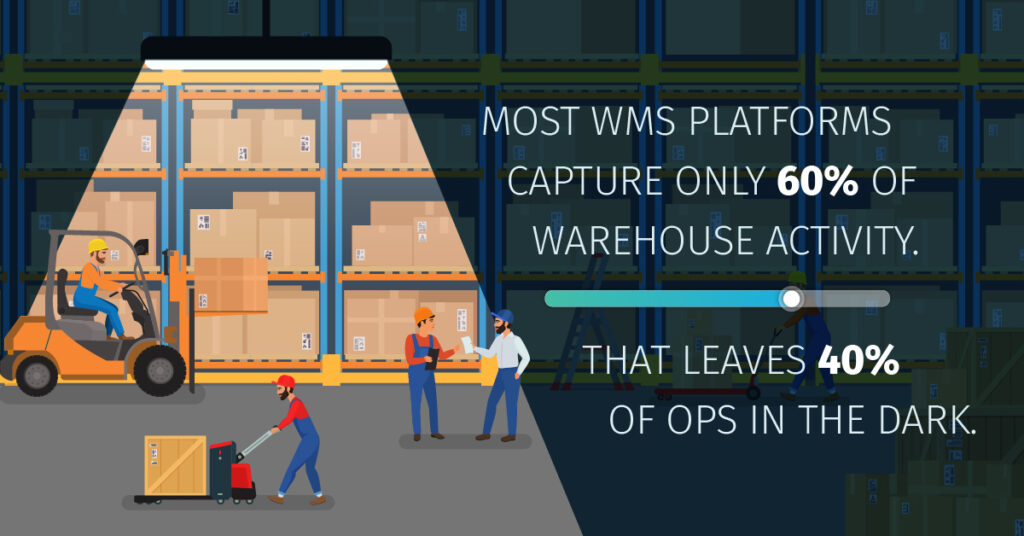
That missing 40%? It’s where profit goes down the drain – through untracked travel time, excess inventory, overhead costs, excess handling, and poorly utilized labor. And without clear benchmarking, it’s impossible to separate performance issues from product mix challenges or shifts in customer behavior.
WPM solves that by giving you:
- A clean, unified data model across all your systems
- Normalized data that supports network-wide benchmarking and performance reviews
- Near real-time dashboards and alerts on performance dips
- Accurate demand forecasting based on historical trends
- Continuous improvement tools that tie actions to results
When you’ve got hundreds of customer orders flowing through the system, the ability to course-correct in real time prevents customer dissatisfaction.
Key Capabilities of Warehouse Performance Management
When taking on a warehouse operations transformation, it’s important to understand what’s involved and what it can do. Beyond boosting warehouse performance and efficiency with the right data insights, it also helps set the stage for future improvements and being ready for new opportunities.
Unified Data Model
Your data exists in multiple places. A unified data model pulls from your WMS, labor management systems (LMS), transportation management system (TMS), finance systems, and even engineering spreadsheets. We clean and normalize it automatically—so you’re working with a single, trustworthy dataset.
Network Benchmarking
Compare performance fairly across sites adjusted for inventory levels, product types, labor mix, and customer expectations. See who’s outperforming, and who needs support. Benchmark essential warehouse KPIs to drive performance.
Activity-Based Costing
Want to know your true cost per pick line? Per return? Per order? Activity-based costing breaks down cost drivers at the task level so you can allocate smarter and drive better pricing.
Continuous Improvement
Model out improvement opportunities before committing time or budget. Run scenarios, track implementation results, and reduce risk in your change management process.
Data-Driven Standards
Use your own data to build and refine labor standards without stopwatches or consultants. Validate against historical data, adjust for seasonality, and roll out with confidence.
Profit Management
Get a clear view of gross and net margin by customer. Prorate fixed costs, track order fulfillment performance, and reduce customer-specific overhead costs without sacrificing service.
Who Uses Warehouse Performance Management?
Whether you’re in a high-volume 3PL or a dedicated fulfillment center for your own products, WPM helps senior leaders cut through the noise. The most common users include:
Operations Executives
Align labor efficiency and overhead costs with company targets.
Finance Leaders
Tie labor and automation investments to cost per unit and customer profitability.
Warehouse Managers
Gain visibility into what’s happening on the floor—where delays occur, why errors happen, and what’s slowing order processing.
Industrial Engineers
Use performance data to improve slotting, storage space layout, and material flow.
Results of a Well-Functioning WPM System
In a volatile world, having more control of any variables that can be managed is essential. Companies using WPM typically see:
- 5%+ reduction in labor costs via improved utilization and process flow
- Improved inventory turnover due to reduced stock handling and improved picking accuracy
- Better alignment of human resources and automation, reducing repetitive tasks and improving labor retention
- Faster time-to-value on process improvement initiatives
- Enhanced customer satisfaction driven by order accuracy and fulfillment speed
- Clearer forecasting and inventory management aligned to real-world demand
- A full understanding of the costs (and profit potential) for each customer, known as cost to serve
- More efficient warehouse operations and fewer costly surprises
Get Started with Easy Metrics
Warehouse Performance Management isn’t just another analytics layer. It’s how operations teams finally gain control of complex, fast-moving environments.
Whether you’re tackling high costs, managing storage capacity, optimizing inventory tracking, or trying to understand how customer behavior is affecting demand, Easy Metrics gives you the clarity and tools to act.
With a unified data model, we help you focus on the right metrics that drive an effective warehouse so you can keep your supply chain management strategy running at full speed.
Unify Your Warehouse Data
Learn how unified data improves visibility, labor performance, and AI readiness across your network.