Building a new distribution center, relocating an existing facility, or investing millions in robotics and automation can transform warehouse performance. But when the underlying business case relies on average costs, assumed productivity, and projected volumes, the financial risks can be substantial.
In November 2025, Kroger announced plans to close three automated fulfillment centers and cancel a planned fourth location after its automated fulfillment network failed to meet financial expectations. The company ultimately recorded approximately $2.5 billion in impairment and related charges for 2025.
The lesson is clear: an investment that looks compelling on paper must deliver value under actual operating conditions.
Know Your Costs Before You Move or Build
Moving a distribution center or opening a greenfield facility involves more than comparing real estate, wages, and transportation costs.
The business case must also account for the cost of performing the work itself: receiving, putaway, replenishment, picking, packing, shipping, returns, and indirect activities.
A greenfield operation also introduces substantial startup expenses: facility preparation, systems integration, equipment installation, hiring, training, inventory transfers, and reduced productivity during ramp-up.
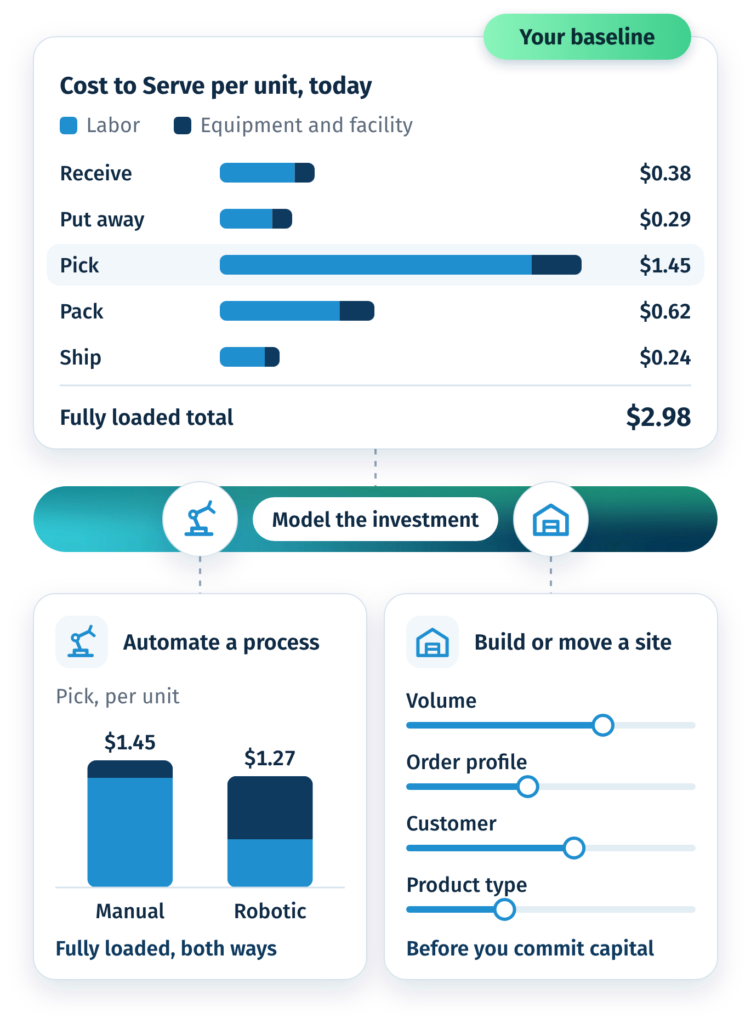
Activity-based Cost to Serve creates a more reliable starting point. With actual process costs from existing facilities, companies can model how different volumes, order profiles, customer requirements, labor rates, and operating configurations will affect the economics of a new location.
Instead of assuming the new operation will be more efficient, Finance and Operations can quantify what must change to make the investment worthwhile.
Evaluate Robotics on Total Cost, Not Just Labor Savings
Robotics investments are frequently justified by projected reductions in labor hours. But eliminating manual work doesn’t eliminate the cost of performing it.
Robots introduce new expenses: acquisition or subscription fees, depreciation, maintenance, software, power, support, and sometimes additional labor to operate or maintain the system.
The economics also depend on utilization. A robotics fleet operating near capacity across multiple shifts has a fundamentally different cost per transaction than one running below capacity.
With Cost to Serve, companies can compare the fully loaded cost of a robotic process with its manual equivalent, including both labor and nonlabor costs. They can evaluate which processes benefit most, how quickly the investment can pay back, and whether anticipated volumes support the business case.
Make Large Automation and Equipment Investments Accountable
Conveyors, automated storage and retrieval systems, sortation equipment, and other large capital investments introduce long-term fixed costs into warehouse operations.
The question isn’t simply how much throughput a system can handle. It’s how much it will actually handle—and at what cost.
Activity-based costing connects equipment operating costs, depreciation, maintenance, and utilization to the processes that consume those resources.
This makes it possible to model alternative operating scenarios before committing capital and measure actual performance after deployment.
Are automation assets being used enough to justify their cost? Has the investment reduced total process costs, or merely shifted expenses from labor to equipment? Are higher volumes improving unit economics as expected?
These are questions that traditional labor productivity metrics alone cannot answer.
Measure the Business Value After the Investment
The investment decision is only the beginning. Once a facility opens or equipment is deployed, the same Cost to Serve model can measure whether the projected benefits are being realized.
Easy Metrics combines granular labor Cost to Serve with Advanced Cost Allocation to allocate robotics, automation, equipment, facility expenses, and other shared costs to the elements that consume them.
That gives Finance and Operations a consistent view of actual costs by facility, process, customer, product family, and order profile—before and after the investment.
The result is a stronger business case before committing capital and a way to verify ROI once the investment is operating.
Warehouse investments shouldn’t depend on assumptions that become impossible to validate. With activity-based Cost to Serve, companies can plan with real operational data, understand the utilization required for success, and measure the financial value their investments actually deliver.